
Jackals Among Wolves Canid News 2026 issue 1
Wolves and jackals: rivals by nature, or reluctant table mates?
Classic ecology predicts that apex predators like the grey wolf (Canis lupus) suppress smaller carnivores. Yet a long-term study in Greece reveals a more flexible relationship with the golden jackal (Canis aureus), driven by human-provided food.
Across rural areas, livestock carcasses left in the open create a substantial food subsidy. From 2018 to 2024, researchers recorded over 1,400 carcasses and thousands of wolf and jackal detections using thermal imaging and camera traps, revealing unexpected patterns of coexistence.
Bigger carcasses, greater tolerance
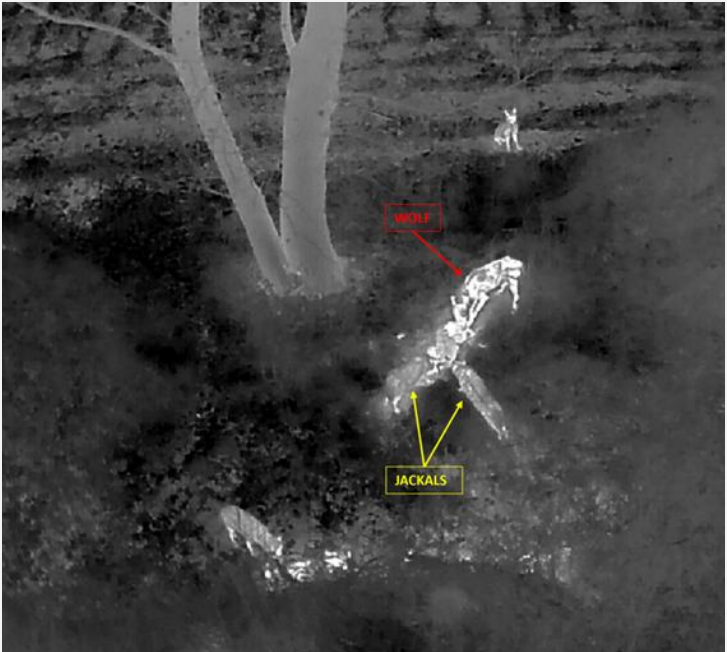
Wolves and jackals were frequently observed together, sometimes feeding side by side. Co-feeding was most common at large carcasses (>100 kg), where abundant food reduced the benefits of aggression. Wolves were usually solitary, while jackals formed larger groups, yet close-range feeding was common.
Competition has not disappeared
Conflict still occurred. In several cases, large jackal groups displaced lone wolves, and one incident of wolf predation on a jackal was recorded. The traditional hierarchy remains, but is less rigid than expected.
A human-shaped coexistence
These findings show that anthropogenic food subsidies can reshape carnivore interactions, reducing competition and promoting temporary coexistence. Wolf–jackal dynamics appear context-dependent rather than strictly hierarchical.
As carnivores increasingly share human-dominated landscapes, understanding these shifts is essential. Sometimes, coexistence begins with shared resources.
Reference
Kominos T, Galanaki A, Naziridis T, Gasteratos I, Giannatos G, Chylarecki P, Bogdanowicz W. 2026. Jackals among wolves: balancing between competition and tolerance. Proceedings of the Royal Society B 293: 20252832. https://doi.org/10.1098/rspb.2025.2832