
Dholes in your hot brew Canid News 2026 issue 2
Dholes (Cuon alpinus) are among the top predators in South and Southeast Asia’s forest systems. The highly social canids typically prefer dense forested habitats and avoid areas with human activity. Since dhole packs and populations are largely confined to relatively undisturbed forest habitats in the tropics, most of our understanding of the species comes from research within Protected Areas. Over the last decade or so, anecdotal observations and exploratory research began hinting at dhole presence even in human-dominated multi-use landscapes.
To understand how this elusive carnivore shares space with people, we focused on the human-altered agroforest landscape of Valparai in India’s biodiverse Western Ghats. The Valparai plateau is a spectacular mosaic of tea, coffee, and cardamom plantations dotted with rainforest fragments. Surrounded by Protected Areas on three sides, the plateau is home to over 70,000 people, their livestock, and a rich diversity of wild animals, including leopards, elephants, and primates.
Tracking the packs
We used a multi-pronged approach to assess dhole ecology at both the population and pack levels in Valparai. Overlaying a grid across the landscape, we conducted systematic camera-trapping and indirect sign surveys. Marking perhaps the first effort to characterize carnivore microhabitat features in India, we used a local informant network to locate packs and measure fine-scale features like vegetation cover, refuge structure and field of vision. Finally, we collected fecal samples from latrine sites to evaluate their diet.
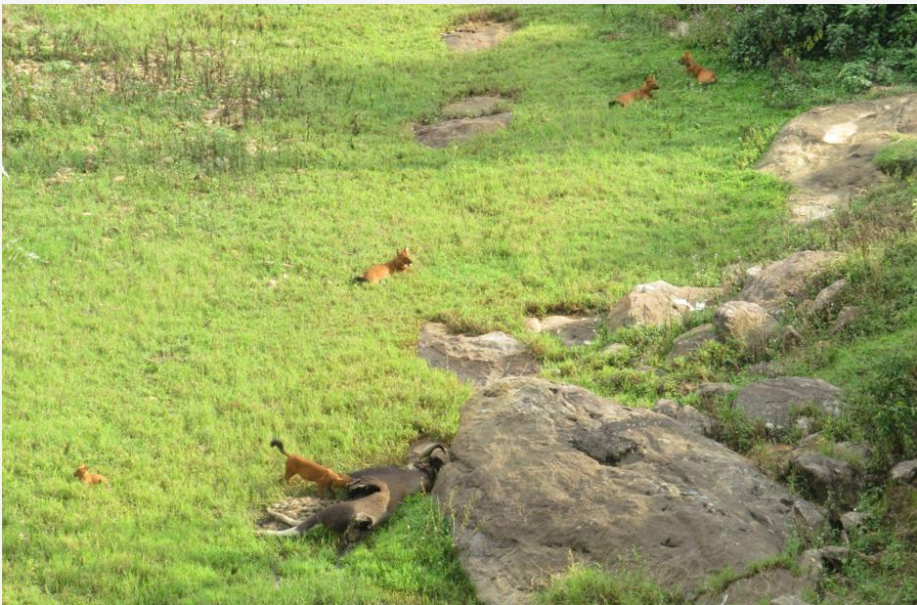
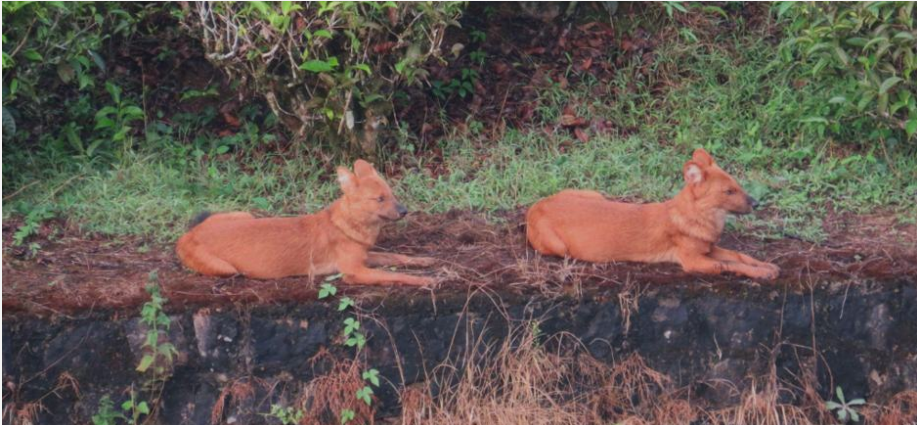
A unique blend
Contrary to expectations based on protected area-centered past research, dholes in the agroforests of Valparai did not strictly track the distribution of their primary prey. Instead, our spatial analysis showed that they had a higher probability of using flatter areas away from human settlements while preferring fragmented tree cover, such as rainforest patches and eucalyptus plantations. There were also non-negligible overlaps between high dhole use areas and livestock activity. At a finer scale, dhole packs chose microhabitats offering a strategic trade-off: dense vegetation for refuge combined with clear sightlines that enabled vigilance and hunting.
Coexistence in shared spaces
Despite high overlap in dhole use sites and high abundance of livestock in the landscape, fecal analysis showed that wild prey (sambar deer, gaur, wild pigs, muntjac deer) dominated dhole diet. However, we also detected poultry remains in their diet; follow-up camera trapping confirmed that dholes were scavenging chicken from local waste-dumping sites. Our work shows that agroforests like tea can serve as ideal secondary habitats and need to be viewed as future conservation landscapes for dhole metapopulations across Asia.
Reference
Pious, A., Das, A., Thasmai, H.S., Ganguly, D., Sharma, A.D., Sheikh, S., Srivathsa, A. 2026. Tea for two: India’s commodity agroforests as coexistence landscapes for the endangered Asiatic wild dogs and people. Ambio 55, 1026–1038. https://doi.org/10.1007/s13280-025-02260-3