
Climate drives jackal expansion across Eurasia Canid News 2026 issue 2
The golden jackal (Canis aureus) is undergoing one of the fastest natural range expansions ever documented in a European mammal. Once largely confined to southeastern Europe, the species has spread rapidly over the last few decades and is now established as far north as Estonia, with recent records from Fennoscandia and the Iberian Peninsula.
What is enabling this remarkable expansion?
An international team of researchers addressed this question using one of the largest genomic datasets ever assembled for the species. By analysing nearly 20,000 genome-wide genetic markers (SNPs) from over 360 golden jackals sampled across Eurasia, the researchers investigated how climate, landscape, and human-related factors influence gene flow, local adaptation, and future expansion.
Climate shapes genetic connectivity
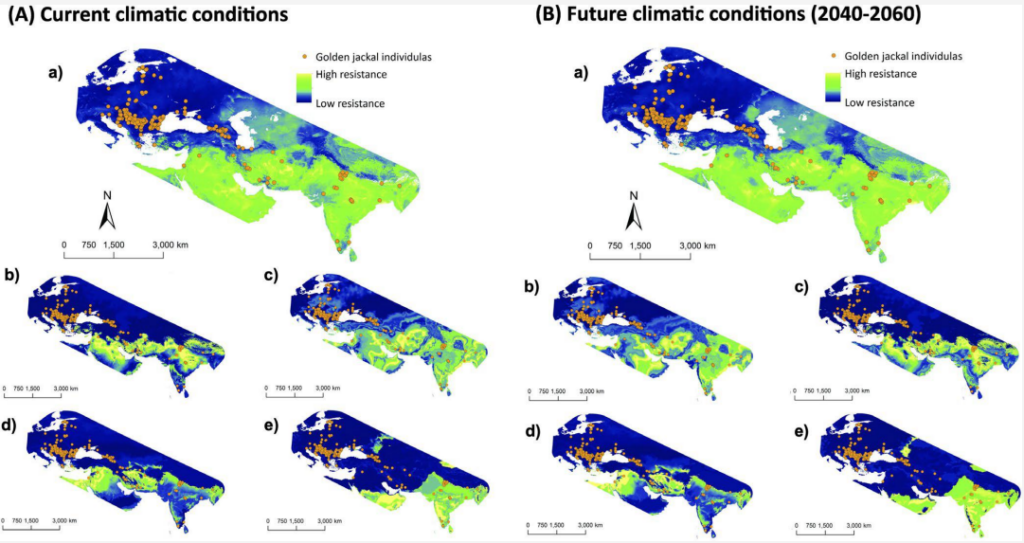
While geographic distance remains the primary factor influencing genetic patterns across the entire range, climate is the strongest environmental driver of gene flow and local adaptation. Variation in temperature and precipitation explains how populations remain genetically connected across the landscape.
Europe offers few climatic barriers
Connectivity models reveal remarkably low resistance to dispersal throughout most of Europe. This suggests that golden jackals are likely to continue expanding northward and westward as climatic conditions become increasingly favourable.
Evidence of adaptation to colder environments
The study detected strong genomic signatures associated with winter temperature and precipitation, indicating ongoing local adaptation that may facilitate the species’ successful colonisation of northern Europe.
Hybridisation with dogs is not driving the expansion
Although some jackals carry traces of domestic dog ancestry, admixed and non-admixed individuals occupy similar habitats. The findings indicate that hybridisation has played little role in shaping the species’ rapid range expansion.
Why does it matter?
The study provides one of the clearest examples of how climate change can influence the distribution of a highly adaptable mammal. Rising temperatures and changing precipitation patterns are creating increasingly favourable conditions for the golden jackal across much of Europe, while some populations in southern parts of the range in Asia may face declining habitat suitability in the future.
The authors emphasise that conservation and management should account for functional connectivity across the species’ expanding range and recommend continued genomic monitoring, particularly in regions linking Europe and Asia, where future changes in connectivity may be especially important.
Reference
Flores-Manzanero, A., W. Bogdanowicz, M. Stefanović, …, M. Pilot. 2026. Climate as the Main Driver of Large-Scale Genetic Patterns and Connectivity in the Expanding Golden Jackal. Global Change Biology 32(4): e70879. https://doi.org/10.1111/gcb.70879