
The Pakistan Wolf Project Canid News 2026 issue 1
The Pakistan Wolf Project aims to study and conserve grey wolves (Canis lupus) in Pakistan by investigating their ecology, genetics, and interactions with people. A central goal is to clarify the distribution of the Indian wolf (C. l. pallipes), following recent findings that Pakistan is a global hotspot for wolf diversity.
Grey wolves comprise three major genetic lineages: the widespread Holarctic wolf, the Himalayan (Tibetan) wolf (C. l. chanco), and the Indian wolf, the most ancient lineage, restricted to the plains and grasslands of the subcontinent. Pakistan represents a unique contact zone where these lineages meet, particularly around Kashmir, though large regions remain poorly sampled.
Wolves in Pakistan face multiple threats, including habitat loss, human–wildlife conflict, poaching, and hybridisation with free-ranging dogs. Addressing these challenges requires stronger ecological and genetic data to guide conservation.
Since late 2024, the project has conducted fieldwork across southern Pakistan, documenting wolf presence, livestock depredation, and local knowledge while building partnerships with provincial wildlife departments.
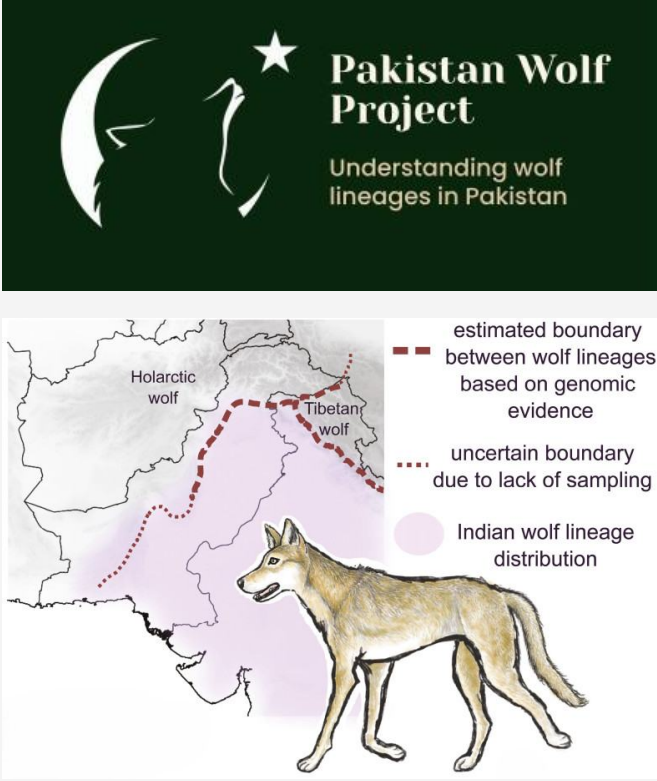
A three-pronged approach
The project uses a three-pronged approach based on non-invasive methods:
1. Camera trapping to assess distribution and ecology
2. Genetic sampling to identify lineages and connectivity
3. Community interviews to document conflict and perceptions
Initial results include photographic records of wolves and genetic samples from previously unsampled regions, now under analysis. Interviews in Kirthar National Park indicate repeated depredation events, though attribution to wolves remains uncertain.
A priority for conservation
Southern Pakistan remains one of the least studied regions for wolf ecology. With as few as ~42 breeding pairs of Indian wolves estimated in the country, confirming lineage identity and protecting core habitats is critical.
By combining field data with local knowledge, the Pakistan Wolf Project aims to support science-based conservation and informed coexistence strategies in this understudied region.
Reference
Hennelly et al. (2024), Genomic analysis of wolves from Pakistan clarifies boundaries among three divergent wolf lineages, Journal of Heredity. https://doi.org/10.1093/jhered/esad066